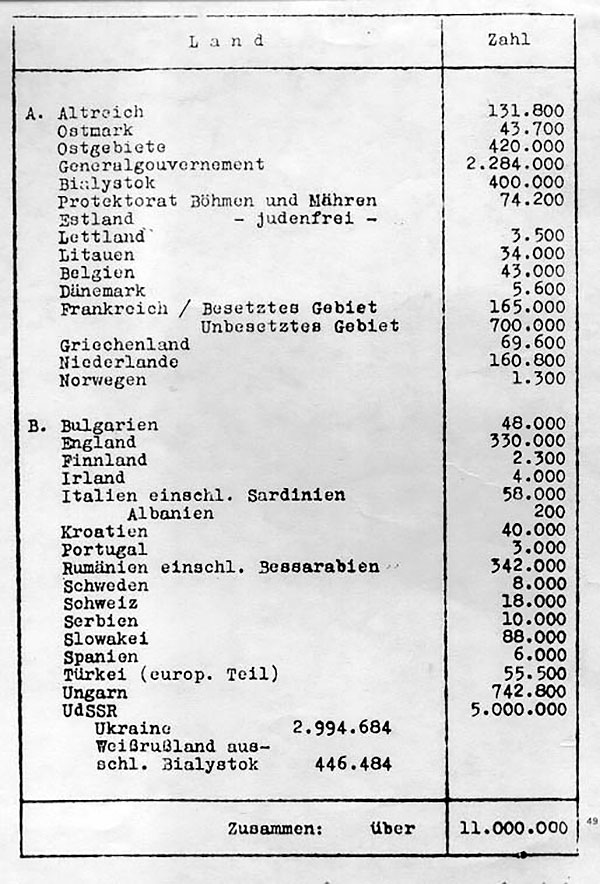
List of Jewish populations by country used at the Wannsee Conference attended by Nazi Party and government officials in January 1942
In preparation for the conference, Eichmann drafted a list of the numbers of Jews in the various European countries. Countries were listed in two groups, “A” and “B”. “A” countries were those under direct Reich control or occupation (or partially occupied and quiescent, in the case of Vichy France); “B” countries were allied or client states, neutral, or at war with Germany. The numbers reflect the estimated Jewish population within each country; for example, Estonia is listed as Judenfrei (free of Jews), since the 4,500 Jews who remained in Estonia after the German occupation had been exterminated by the end of 1941. Occupied Poland was not on the list because by 1939 the country was split three ways among Polish areas annexed by Nazi Germany in the west, the territories of Poland annexed by the Soviet Union in the east, and the General Government where many Polish and Jewish expellees had already been resettled.
Heydrich opened the conference with an account of the anti-Jewish measures taken in Germany since the Nazi seizure of power in 1933. He said that between 1933 and October 1941, 537,000 German, Austrian, and Czech Jews had emigrated. This information was taken from a briefing paper prepared for him the previous week by Eichmann.
Heydrich reported that there were approximately eleven million Jews in the whole of Europe, of whom half were in countries not under German control. He explained that since further Jewish emigration had been prohibited by Himmler, a new solution would take its place: “evacuating” Jews to the east. This would be a temporary solution, a step towards the “final solution of the Jewish question”.
…Heydrich spoke for nearly an hour. Then followed about thirty minutes of questions and comments, followed by some less formal conversation. Otto Hofmann (head of the SS Race and Settlement Main Office; RuSHA) and Wilhelm Stuckart (State Secretary of the Reich Interior Ministry) pointed out the legalistic and administrative difficulties over mixed marriages, and suggested compulsory dissolution of mixed marriages or the wider use of sterilisation as a simpler alternative. Erich Neumann from the Four Year Plan argued for the exemption of Jews who were working in industries vital to the war effort and for whom no replacements were available. Heydrich assured him that this was already the policy; such Jews would not be killed. Josef Bühler, State Secretary of the General Government, stated his support for the plan and his hope that the killings would commence as soon as possible. Towards the end of the meeting cognac was served, and after that the conversation became less restrained. “The gentlemen were standing together, or sitting together”, Eichmann said, “and were discussing the subject quite bluntly, quite differently from the language which I had to use later in the record. During the conversation they minced no words about it at all … they spoke about methods of killing, about liquidation, about extermination.” Eichmann recorded that Heydrich was pleased with the course of the meeting. He had expected a lot of resistance, Eichmann recalled, but instead, he had found “an atmosphere not only of agreement on the part of the participants, but more than that, one could feel an agreement which had assumed a form which had not been expected”.
(Source)