Tag

Tag: nazi

Picture Of The Day

Picture of the Day

WannseeList

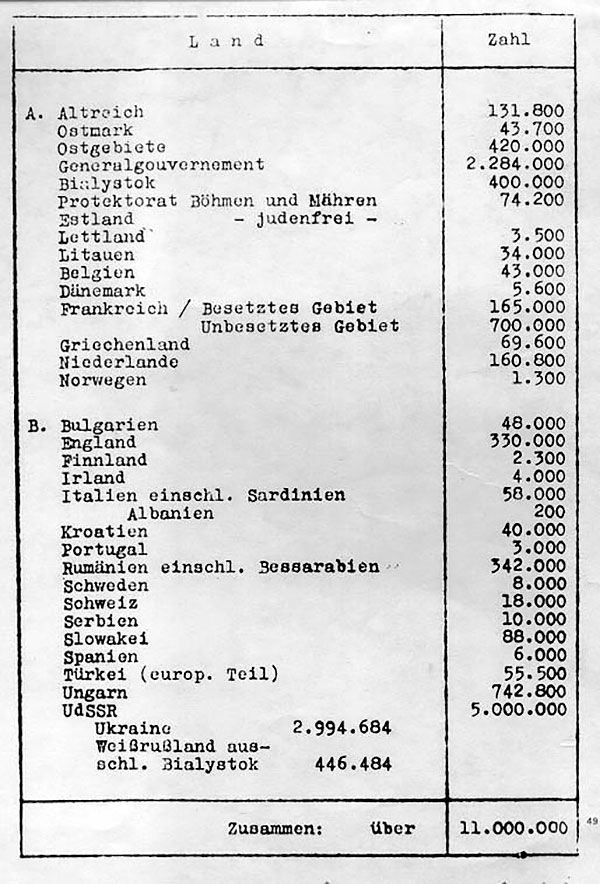
List of Jewish populations by country used at the Wannsee Conference attended by Nazi Party and government officials in January 1942

In preparation for the conference, Eichmann drafted a list of the numbers of Jews in the various European countries. Countries were listed in two groups, “A” and “B”. “A” countries were those under direct Reich control or occupation (or partially occupied and quiescent, in the case of Vichy France); “B” countries were allied or client states, neutral, or at war with Germany. The numbers reflect the estimated Jewish population within each country; for example, Estonia is listed as Judenfrei (free of Jews), since the 4,500 Jews who remained in Estonia after the German occupation had been exterminated by the end of 1941. Occupied Poland was not on the list because by 1939 the country was split three ways among Polish areas annexed by Nazi Germany in the west, the territories of Poland annexed by the Soviet Union in the east, and the General Government where many Polish and Jewish expellees had already been resettled.

Read the rest: Picture of the Day
Answers

What Life Was Like Under Nazi Occupation?

german occupation of france

The most quickly felt impact of German occupation was general shortage. All products of value were seized by the Germans, and French citizens received ration cards for just about everything. Coal and fuel were difficult to get, so people were freezing in winter time, made their own clothes, and mostly used bicycles. Food shortage was most felt in cities : meat, coffee, fruit, sugar, almost everything was scarce. As rutabagas and Jerusalem artichokes became staple diets, there was immediately a thriving black market. Wholesale dealers of “butter, eggs and cheese” made fortunes buying restricted products from farmers.

Read the rest: What Life Was Like Under Nazi Occupation?
Picture Of The Day

Picture of the Day

Irena Sendler

This is Irena Sendler, a Polish social worker and nurse who smuggled approximately 2,500 Jewish children out of Nazi-occupied Warsaw.

She entered the ghetto using a special work pass and would smuggle out children in the bottom of her toolbox and also utilize her burlap sack for larger kids. She also used ambulances and sewers to get them out of the ghetto.

Read the rest: Picture of the Day
Answers

How Did Germany De-Radicalize Its People After The Fall of The Nazi Party?

(Force confrontation: German soldiers react to footage of concentration camps, 1945.)

The process of denazification and the trials of various war criminals in Germany was enormous. The Nazi party had 8.5 million members by the end of the war. Somewhere in the region of 18 million people served in the German armed forces during the war, many of whom had committed atrocities and war crimes. 17.2 million people voted for the Nazi party in the 1933 election. Almost 22 million had been members of the German Labour Front, the Nazi replacement for the Trade Unions. Perhaps as many as 45 million individuals were members of or associated with organs of the Nazi party. As such, the process of denazification would have to be conducted on an epic scale.

Read the rest: How Did Germany De-Radicalize Its People After The Fall of The Nazi Party?
main

Picture of the Day

french collaborator

French female collaborator punished by having her head shaved to publicly mark her, 1944

Throughout France, from 1943 to the beginning of 1946, about 20,000 women of all ages and all professions who were accused of having collaborated with the occupying Germans had their heads shaved. Just as the identity of those who carried this task out varied so too did the form it took.

Read the rest: Picture of the Day
Picture Of The Day

Picture of the Day

4 Barreled .22cal Nazi Belt Buckle Gun

The Marquis Belt Buckle pistol, also known informally as the Power Pelvis Gun, was conceived by Louis Marquis while interned in a POW camp during World War I. Frustrated by long chow and loo lines, Marquis was consumed by a desire to exert his authority over other POW’s without drawing the attention of guards โ€“ hence the idea for a concealed weapon not requiring the use of hands or traditional holsters. Named the Koppelschlosspistole, the design was patented before the outbreak of World War II. The patent was issued in late 1934 for a “trommelrevolver” to be mounted on a belt. Both .22 (four barrel) and .32 (two barrel) versions were produced in very limited numbers.

Read the rest: Picture of the Day
main

Picture of the Day

amon goeth

Amon Leopold Goeth, camp commander of the Plaszow concentration camp from February 1943 until September 1944. In the photograph, he can be seen standing on his balcony preparing to shoot prisoners.

Amon Leopold Goeth, the villain of the movie Schindler’s List, was born in 1908 in Vienna, Austria. At the age of 24, he joined the Nazi party. In 1940, Amon Goeth became a member of the Waffen-SS. He was assigned to the SS headquarters for Operation Reinhard in Lublin in German-occupied Poland in 1942. Operation Reinhard was the plan to evacuate the Jews from the Ghettos in Poland to three death camps: Treblinka, Sobibor, and Belzec, all of which were in eastern Poland.

Read the rest: Picture of the Day
Life Experiences

The Thoughts And Feelings Of A Nazi SS Guard As He Is About To Execute 23 People

Felix Landau was a member of the feared German SS. For much of the war he belonged to an Einsatzkommando, a mobile death squad charged with exterminating Jews, Romani gypsies, Polish intellectuals, and a number of other groups within Nazi-occupied territory. Landau operated throughout Poland and Ukraine, slaughtering his way from town to town.

His remarkable diary details his appalling crimes, often in graphic detail. This entry, from July 1941, records his actions in the city of Drohobych in western Ukraine.

The lack of emotion he feels during the killings is typical of SS officers who took part in mass executions.

Read the rest: The Thoughts And Feelings Of A Nazi SS Guard As He Is About To Execute 23 People