Tag

Tag: ww1

Picture Of The Day

Picture of the Day

4 people from the same town who fought in different wars.

4 people from the same town who fought in different wars.

The eyes of four men, captured in a single photograph, tell a story of approximately 80 years of warfare. The horrors they witnessed and the experiences they shared are reflected in their eyes, growing more profound as they aged. Each of these men went to war, yet their experiences spanned completely different types of warfare.

Read the rest: Picture of the Day
Picture Of The Day

Picture of the Day

trench clubs

Maces and Clubs used by Austro-Hungarian Army during WW1, 1914-1918

During the grueling battles of World War I, ground troops relied on an array of weapons such as rifles, grenades, and bayonets while enduring the harsh conditions of the trenches. However, amidst these well-known tools of warfare, there existed a weapon that

Read the rest: Picture of the Day
Picture Of The Day

Picture Of The Day

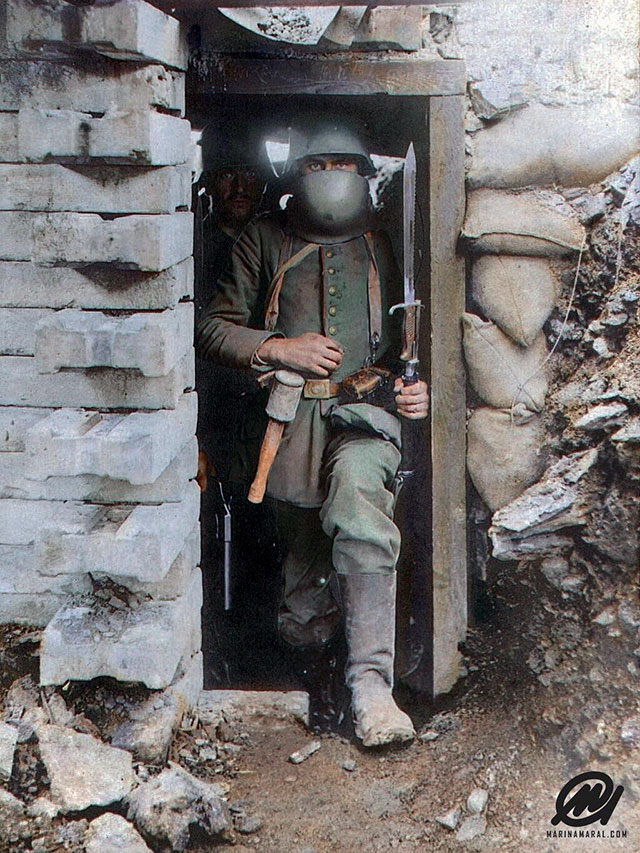
ww1 trench raider

World War 1 Trench Raider

During World War I, trench raiding emerged as a tactic in trench warfare. It involved small-scale surprise attacks on enemy positions under the cover of night.

Typically, raiding parties consisted of small teams of soldiers who would darken their faces with burnt cork before navigating through the barbed wire and debris of no man’s land to infiltrate enemy trench systems. The distance between friendly and enemy front lines varied, but was generally several hundred meters. Daylight raids were futile as enemy machine gunners and snipers had clear visibility of no man’s land and could easily target anyone revealing themselves above the trench parapet.

Read the rest: Picture Of The Day
Picture Of The Day

Picture of the Day

WW1 French trench raider, 1915

These soldiers would sneak out of their own trenches at night, often covering themselves in burn cork to darken their uniforms and exposed skin, silently creeping towards the enemy trench so that they could slit the throats or bash in the heads of the enemy whilst they slept. They would wreak havoc throughout the enemy position, using knives and clubs to maintain minimal noise, and carrying grenades which they would throw into sleeping quarters when they left. The fear factor of that no one could sleep safe, knowing that the enemy sent men like this.

Life Experiences

What Was It Like To Go Through A Gas Attack In World War 1

Arthur Empey was an American living in New Jersey when war consumed Europe in 1914. Enraged by the sinking of the Lusitania and loss of the lives of American passengers, he expected to join an American army to combat the Germans. When America did not immediately declare war, Empey boarded a ship to England, enlisted in the British Army (a violation of our neutrality law, but no one seemd to mind) and was soon manning a trench on the front lines.

Read the rest: What Was It Like To Go Through A Gas Attack In World War 1
Picture Of The Day

Picture of the Day

battle of loos

During the Battle of Loos in 1915, German machine gunners stopped firing out of sheer disgust for the amount of casualties they were inflicting on the British

The Battle of Loos was fought September 25-October 14, 1915, during World War I. Seeking to end trench warfare and resume a war of movement, British and French forces planned joint offensives in Artois and Champagne for late 1915.

Forming into ten assault columns, the 21st and 24th surprised the Germans when they began advancing without artillery cover on the afternoon of the 26th.

Read the rest: Picture of the Day
Picture Of The Day

Picture Of The Day

ww1 bagpiper

Bagpipers were usually the first ones out of the trenches when it was time to fight; playing as they lead the soldiers into each battle in WW1

2500 bagpipe players were in the trenches with their men.

The pipers played the clarion call to arms to the men of the British Expeditionary Forces and thus were usually the first ones “over the top.”

They stood in full view of the German lines playing their instrument, and marched through “no-man’s land” without any ammunition but their sound.

The bagpipe players carried no cutting devices when they encountered barbed wire. Enemy fire mowed them down just as effectively as they killed advancing troops.

600 pipers were wounded, 500 bagpipe players died while rallying the troops into battle.

Read the rest: Picture Of The Day
Picture Of The Day

Picture of the Day

landwehermann

A Prussian Landwehrmann tanning rat skins in a dugout, WWI

A Prussian Landwehrmann tanning rat skins in a dugout, WWI. The trench soldier of WWI had to cope with millions of rats. They were attracted by the human waste of war – not simply sewage waste but also the bodies of men long forgotten who had been buried in the trenches.

Possibly drawing on his pre-war trade in the leather industry, this fellow has set himself up in business, tanning the pelts in the age-old method of separating soil and gore from the skin, before they are washed and spread out to dry (as depicted here). It’s possible that he used the skins to make patches for repairs to uniforms. Some of these rats grew extremely large. Many troops were awakened by them crawling across their faces, or attempting to take food from the pockets of sleeping men.

Read the rest: Picture of the Day
TRUTH

What Was It Like In The Trenches Of World War 1?

trench warfare world war 1

It’s not nearly as dramatic as you may think. The unfortunate truth for Hollywood is that most of WWI was sitting around improving defenses and doing basically nothing.

The conditions were horrific the entire time for most parts but you were not constantly getting out of trenches and charging enemies most of the time.

One of the biggest jobs of men on the front is to constantly check, repair and lay down barbed wire outside of their trenches. This was generally done at night for obvious reasons and generally required hundreds of men to cover the workers doing this.

Read the rest: What Was It Like In The Trenches Of World War 1?