
Before NASA sent a man to space, they decided to send a chimp first. And on January 31, 1961, a chimp named Ham received the dubious "honor" of making this historic trip.
Captured in French Cameroon in 1957, Ham was one of 39 chimps selected for NASA training. He had beaten out all of his competitors with his ability to pull levers quickly, but his preparation for the trip was anything but easy.
He endured hours of avoidance conditioning training, which involved electric shocks to his feet if he didn’t pull levers in time, as well as tests to see whether he could endure the massive g-forces that spaceflight would inflict on his body.
On January 31, 1961, Ham was secured in a Project Mercury mission designated MR-2 and launched from Cape Canaveral, Florida, on a suborbital flight.
Ham’s vital signs and tasks were monitored by sensors and computers on Earth.
The capsule suffered a partial loss of pressure during the flight, but Ham’s space suit prevented him from suffering any harm.
Ham’s lever-pushing performance in space was only a fraction of a second slower than on Earth, demonstrating that tasks could be performed in space.
Ham’s capsule splashed down in the Atlantic Ocean and was recovered by the USS Donner later that day.
His only physical injury was a bruised nose. His flight was 16 minutes and 39 seconds long.
When he returned from his suborbital flight, he appeared to "smile" for the cameras, but his trainer and other primatologists said that this facial expression was actually a sign of terror.
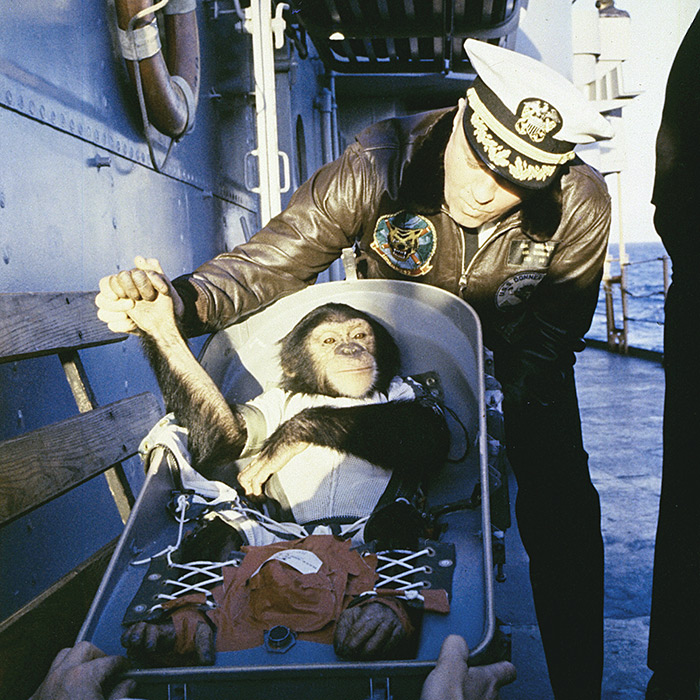
He even refused to get back into the capsule for a photo op that NASA wanted.
On April 5, 1963, Ham was transferred to the National Zoo in Washington, D.C. where he lived for 17 years before joining a small group of captive chimps at North Carolina Zoo on September 25, 1980.
After his death on January 19, 1983, Ham’s body was given to the Armed Forces Institute of Pathology for necropsy.
Following the necropsy, the plan was to have him stuffed and placed on display at the Smithsonian Institution, following Soviet precedent with pioneering space dogs Belka and Strelka.
However, this plan was abandoned after a negative public reaction.
Ham’s remains, minus the skeleton, were buried at the International Space Hall of Fame in Alamogordo, New Mexico.
Colonel John Stapp gave the eulogy at the memorial service. The skeleton is held in the collection of the National Museum of Health and Medicine.