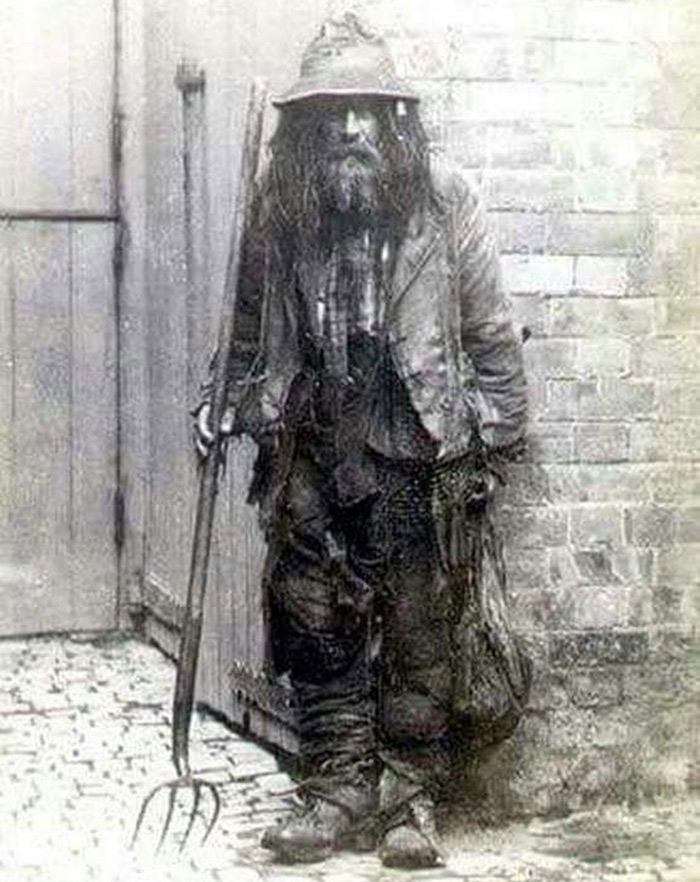
A night soil man who used to take away human waste to be used in fertilizer. Dunston, Lincolnshire, England 1872
The bathroom was not always the clean welcoming place it is today. Before the time of sewers, flushing toilets and urinals was a simple hole dug deep into the ground.
People would do their business in them, and because there was no outlet, the holes would fill up.
Enter the “night soil men” or “gong farmers.”
Night soil was the name given to the buildup of human waste in privies, sometimes called earth closets—it was a better way of saying, well …. a huge pile of crap.
In the dark of night, these men would come in and remove the excrement so that people would not have to see or smell it the following morning.
They would use long-handled shovels to dig out the waste from the makeshift bathrooms, pile it in carts, and haul it away, all in the dead of night.
Each “toilet” needed to be cleaned out about 2 or 3 times a year.
The stinky loads of human waste were taken away and given to farms as fertilizer, although much of it ended up dumped in rivers, lakes, ponds, empty fields, and the like.
As cities grew larger and denser in the 19th century, the paltry urban infrastructure could not handle the sheer tonnage of human waste its residents were producing
In New York, it got so bad that city workers often had to dredge the Hudson and East Rivers of the waste so that boats could maneuver around it and dock.
In Washington, D.C., the waste was dumped in a field near the White House and is thought to have contributed to the death of President William Henry Harrison in 1841, who died just 31 days into his presidency.
Hundreds of men were employed in cities—mostly African-Americans and immigrants who were either independent entrepreneurs or employees of city contractors.
The night men, with their “rude carts,” were considered a nuisance at best.
Their night work also left them vulnerable to hoodlums who sometimes stoned the men and occasionally shot their horses.