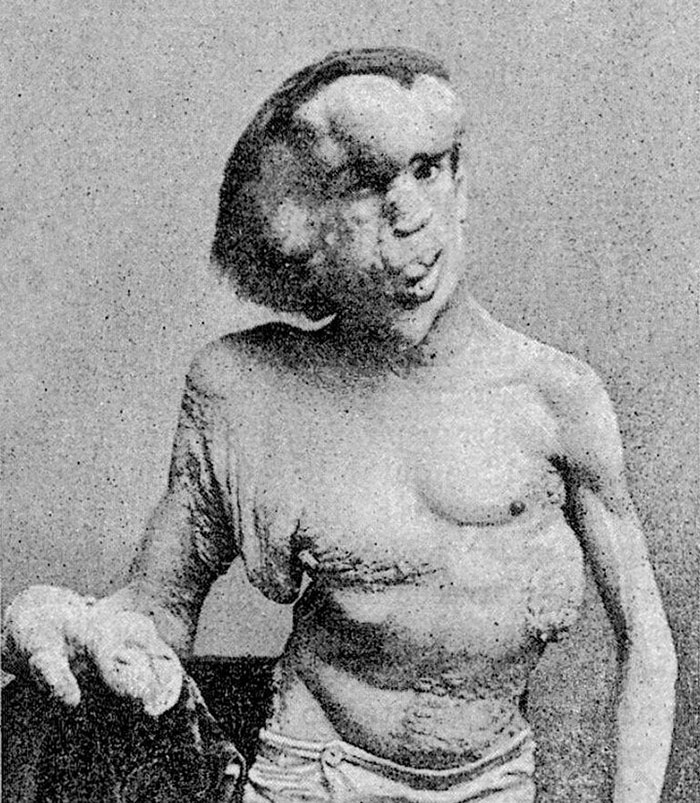
Joseph Merrick, aka The Elephant Man, c. 1889
Joseph Merrick was born in Leicester, Leicestershire, as one of four siblings. During the first few years of his life, he did not show any signs of any disorder. However, as he grew older, a noticeable difference between the size of his left and right arms became apparent, and both his feet became considerably larger.
He also developed thick and lumpy skin, enlarged lips, and a bony lump on his forehead. When he was a child, he fell and injured his hip, which became infected and caused him to be permanently lame. According to the Merrick family, Joseph’s symptoms were a result of his mother Mary being knocked over and frightened by a fairground elephant while pregnant with him. This idea of maternal impression was a common belief in 19th century Britain, and Joseph held this belief about the cause of his condition for the rest of his life.
At the age of 10, Joseph Merrick’s mother passed away, and his father quickly remarried. Joseph left school at 13, which was typical for the time, but struggled to find work. As his physical deformities became more severe, Joseph’s speech became increasingly difficult to understand, and potential customers were repulsed by his appearance. Joseph’s father physically abused him, and feeling rejected by his family, Joseph left home for good. At the age of 17, in late 1879, Joseph sought refuge at the Leicester Union Workhouse, where he remained for four years. Despite his attempts to find work, Joseph was unsuccessful and eventually contacted a showman with the proposal of exhibiting himself as the Elephant Man. Joseph suffered from a genetic disorder that caused significant changes to his skin and bone structure, resulting in over-sized limbs and a head circumference of 91cm. The disease did not affect his left hand.
After arriving in London, Joseph Merrick was displayed in a penny gaff shop on Whitechapel Road, across from the London Hospital. One day, a surgeon named Frederick Treves visited the shop and offered to examine and photograph Merrick. Eventually, Merrick went on tour in Europe but was later robbed by his road manager and left in Brussels. Merrick eventually returned to London, unable to communicate. The police found Treves’ card on him and brought him back to the London Hospital. Although his condition was incurable, Merrick was allowed to remain at the hospital for the rest of his life. Donations from readers of the London Times funded Merrick’s stay at the hospital through the Joseph Merrick Fund. According to Treves, Merrick was intelligent, but naively childlike and had a pleasant character. However, his speech was severely distorted due to his deformities, making it challenging for most people to understand him.
During his four-year stay at the London Hospital, Frederick Treves visited Joseph Merrick daily, and the two became close friends. Merrick also received visits from wealthy individuals in London society. Unfortunately, Merrick’s condition continued to deteriorate, and his facial deformities worsened, causing his head to become even more enlarged. At the age of 27, on April 11th, 1890, Merrick passed away from asphyxia, though Treves, who dissected Merrick’s body, believed that Merrick had died from a dislocated neck. Treves speculated that Merrick, who had to sleep sitting up because of the weight of his head, had attempted to lie down to “be like other people.”